
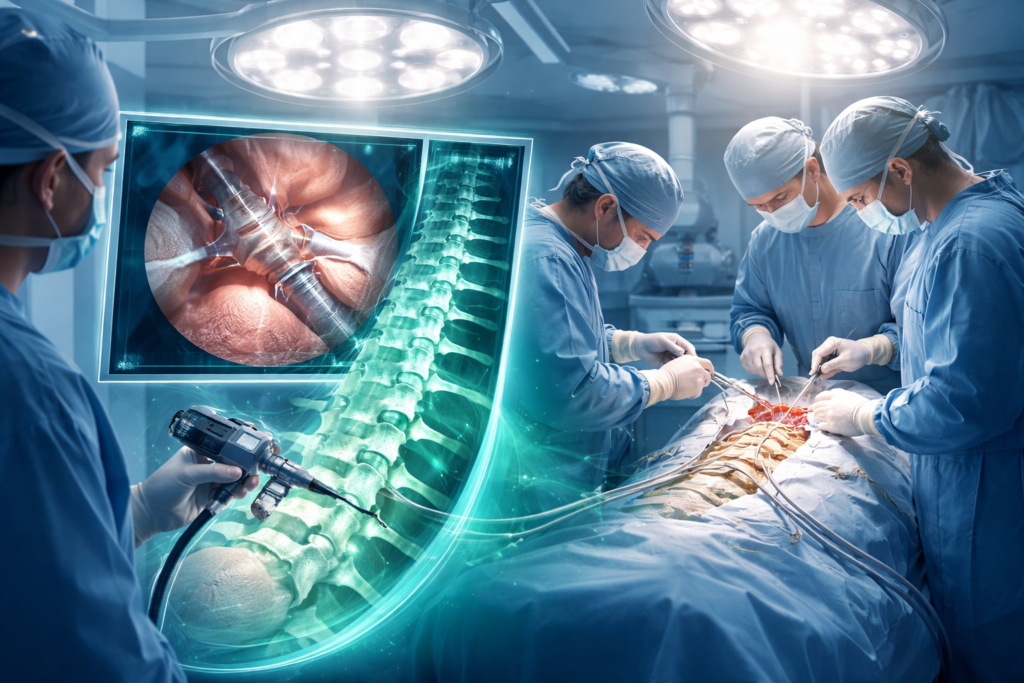
Most people don’t choose spine surgery based on the name of the technique. They choose it based on what life looks like after: pain levels, mobility, time off work, and confidence that the problem was treated safely.
Endoscopic and open spine surgery can be used to address similar issues, especially when the goal is to relieve pressure on a nerve. The biggest difference is not the intent. It’s the access: how the surgeon reaches the spine.
What changes for you as a patient
1) How “big” the operation feels
Open surgery usually creates a wider working window so the surgeon can see and operate directly. Endoscopic surgery works through a smaller corridor using a camera view.
What patients often notice early:
- Open can feel like a bigger physical recovery because more tissue is involved.
- Endoscopic can feel lighter early on because the access path is more targeted.
2) Incision and scarring
Endoscopic procedures typically involve a smaller skin opening. That often translates to:
- A smaller scar
- Less wound discomfort
- Less wound-care hassle in the first week
Open procedures generally involve a larger incision, which can mean more wound sensitivity during early healing.
3) Early soreness and movement
A lot of early recovery is not about the spine itself, it’s about soft-tissue healing.
In general terms:
- Endoscopic approaches often aim to reduce muscle disruption, which can help with early comfort and movement.
- Open approaches may involve more tissue handling, which can make the first phase feel slower.
This is not a guarantee either way. Your baseline fitness, pain tolerance, the exact procedure, and how long the nerve has been irritated matter a lot.
4) Hospital time and the pace back to routine
Endoscopic spine procedures are often planned as shorter stays and, in some centers, outpatient. Open procedures more often require longer observation and a slower ramp-up.
Practical differences patients care about:
- How soon you can walk comfortably
- When you can drive again
- When you can return to work (desk work vs physical work)
- Lifting restrictions and how long they last
The honest part: endoscopy is not “better” for every case
Endoscopic surgery is often a strong fit when the problem is clear and reachable through a narrow view. Open surgery can be the safer choice when the problem is complex or needs broader access.
Open may be preferred when there is:
- Multi-level disease that needs extensive work
- Instability that may require reconstruction or fusion
- Anatomy where wider exposure improves control and safety
A good surgeon should explain the approach in simple terms, tied to your imaging and your symptoms, not marketing language.
B2B perspective: why this difference matters
Endoscopic spine is video-first surgery. The surgeon is working through a live camera feed in a tight space where orientation and visibility can change quickly. That creates a clear opportunity for practical AI support, especially for training and consistency.
Where AI can add value without replacing clinical judgment:
- Real-time anatomy awareness overlays
- Visibility and occlusion detection (blood, debris, fogging)
- Step and workflow recognition to reduce variability
- Training feedback to shorten the learning curve safely
Smart Mirror LLC is building AI that learns from endoscopic video to support safer, more consistent endoscopic workflows, with the surgeon fully in control. If you’re a hospital group, training program, or device partner exploring endoscopic expansion, we’re open to pilots and validation collaborations.